Year: 2021
Medium: Installation
Materials: Approximately 2,900 ceramic cubes, corrugated-cardboard support, fluorescent tube, electrical components and looped audio; L-shaped glass support in the original configuration
Dimensions: Sculptural element: 80 × 30 × 30 cm
Sound loop: 00:01:21
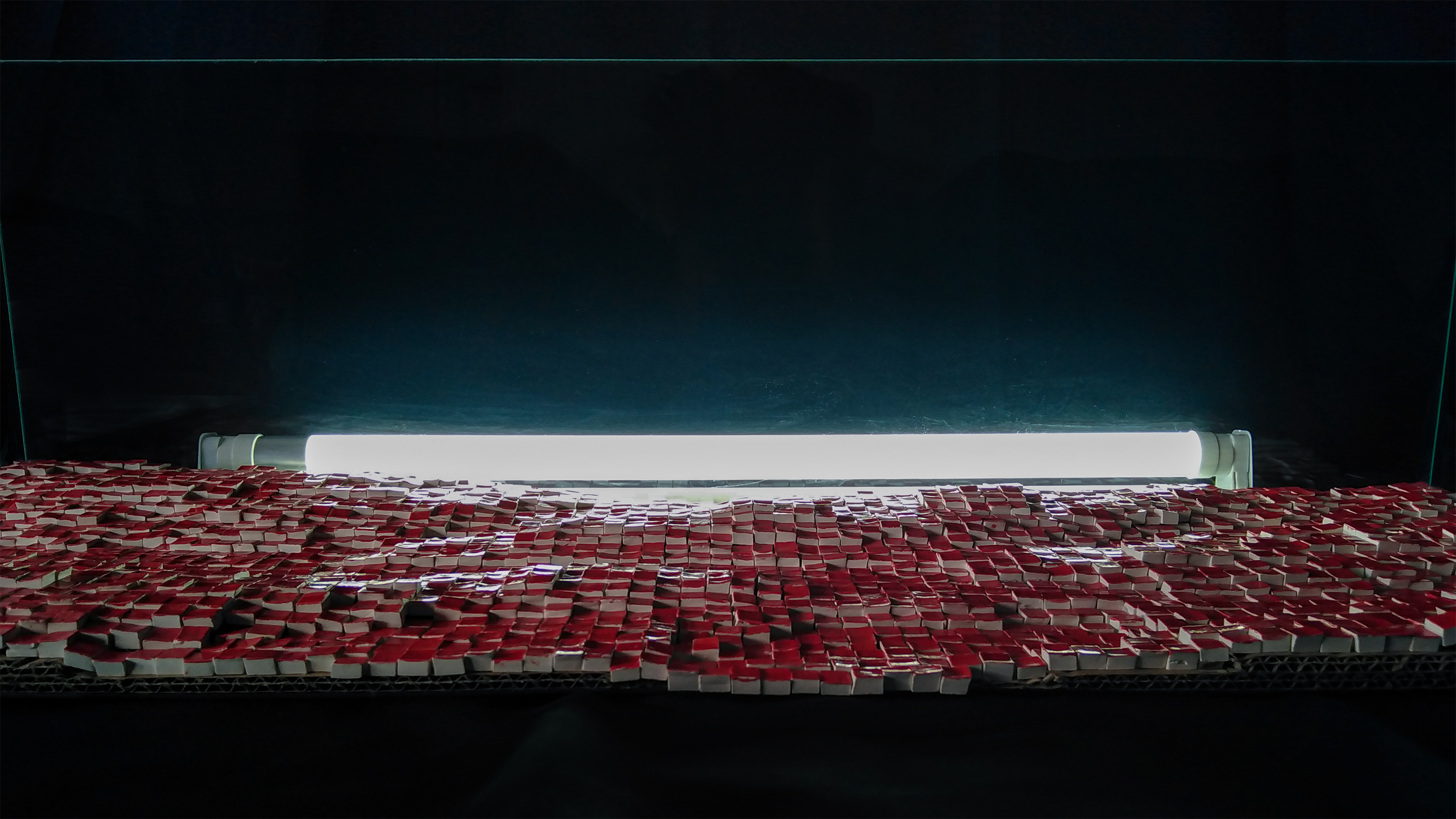
Pixel Sunset constructs an artificial horizon from approximately 2,900 ceramic cubes fixed to a corrugated-cardboard support and illuminated from behind by a fluorescent tube. From a distance, the cubes cohere
into a red field; at close range, the image resolves into individual modules, exposed white edges and small variations in height. The fluorescent tube remains visible, acting simultaneously as a light source and a
horizon line. A looped sound composition adds a temporal layer to the static construction.
By translating the pixel – a uniform and immaterial digital unit- into ceramic, the work replaces digital precision with weight, variation and repetition. Its small scale holds together two incompatible readings: a fragile
model and the suggestion of an expansive landscape. Because the apparatus remains exposed, the illusion is never complete.


